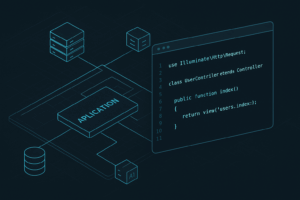
7 Laravel Best Practices for Scalable and Maintainable Code
Struggling with a bloated Laravel codebase? Discover 7 essential Laravel architecture patterns used by professional developers to build scalable, maintainable, and high-performance applications. Start writing cleaner code today.
7 Laravel Best Practices for Scalable and Maintainable Code
Laravel’s elegance is undeniable, offering a joyful and productive development experience right out of the box. However, as applications mature and business logic expands, even the most well-intentioned projects can succumb to complexity. Consequently, without a disciplined approach, your clean codebase can quickly become difficult to maintain and scale.
As a professional software engineer who has navigated these growing pains, I’ve consolidated the most impactful strategies that separate a prototype from a production-ready application. Therefore, by adopting these seven Laravel best practices, you will ensure your project remains robust, performant, and a pleasure to work on.
1. Embrace Skinny Controllers, Fat Services
The “god controller” is a common anti-pattern in growing applications. Essentially, controllers are designed to be HTTP traffic cops—they should direct requests to the appropriate business logic, not contain it.
The Solution: As a result, you should offload complex operations to dedicated Service classes or single-use Action classes. This approach adheres to the Single Responsibility Principle, thereby making your code more testable and reusable.
Instead of:
class OrderController extends Controller
{
    public function store(Request $request)
    {
        // Validate request
        // Charge the user via Stripe
        // Create an order record
        // Update inventory
        // Send a confirmation email
        // ... all in one long method!
    }
}
Refactor to:
class OrderController extends Controller
{
    public function store(CreateOrderRequest $request, CreateOrderAction $action)
    {
        $order = $action->execute($request->validated());

        return response()->json($order, 201);
    }
}
2. Leverage Form Request Validation for Clean APIs
Embedding validation rules directly in your controllers bloats them and violates separation of concerns. Fortunately, Laravel’s Form Request classes provide a dedicated place for authorization and validation logic.
Why it matters: Not only does this keep your controllers lean, but it also centralizes your validation rules and automatically handles failed validation responses. Ultimately, this gives you a cleaner and more consistent API.
3. Adhere to Laravel’s Naming Conventions
Laravel’s “convention over configuration” philosophy is a major driver of its developer efficiency. Conversely, straying from these conventions often leads to more configuration code and confusion.
Stick to the script: For instance, use clear, meaningful names for your models, relationships, and database tables. A User model, for example, will automatically assume its database table is users. Therefore, following these conventions makes your code instantly more readable to any other Laravel developer.
4. Master Eloquent to Prevent Performance Pitfalls
Eloquent ORM is incredibly powerful, but with great power comes great responsibility. In particular, the most common mistake is the N+1 query problem, where a loop triggers an additional database query for each item.
The Fix: Instead, use eager loading with with() to efficiently load relationships in a single query.
Performance Killer:
$books = Book::all();
foreach ($books as $book) {
    echo $book->author->name; // Triggers a new query for each book!
}
Performance Savior:
$books = Book::with('author')->get(); // Loads all authors in one query
foreach ($books as $book) {
    echo $book->author->name;
}
Furthermore, always monitor your query performance using tools like Laravel Debugbar or Telescope.
5. Centralize Configuration with Environment Variables
Hardcoding API keys, database credentials, or service URLs is not only a security risk but also a deployment nightmare. Thankfully, Laravel’s .env file is designed specifically for this.
Best Practice: In other words, any value that changes between environments (local, staging, production) belongs in your .env file. Then, access it cleanly in your code using the config() helper, which provides a cached, high-performance way to retrieve these values.
6. Maintain Your Database with Clean Migrations & Seeders
Your database schema is the foundation of your application. Otherwise, messy, unrepeatable migrations can halt development and deployment in its tracks.
Strategy: Firstly, write clear, incremental migrations. Secondly, use Factories and Seeders to generate dummy data for development and testing. As a result, this ensures your team can work with a consistent dataset and makes your testing process far more reliable.
7. Prioritize Testing from the Start
You don’t need to aim for 100% test coverage on day one; however, ignoring tests entirely is a technical debt that compounds quickly. On the other hand, Laravel’s built-in testing tools are exceptionally powerful and easy to use.
Start Small: For example, write a few simple feature tests for your most critical workflows, like user registration or a payment process. Consequently, this builds a safety net that allows you to refactor and deploy with confidence.
Conclusion: Code with Intention
In summary, Laravel provides a superb foundation, but it’s our responsibility as engineers to build upon it with structure and foresight. By embracing these patterns—skinny controllers, proper validation, and performance-conscious Eloquent usage—you’re not just writing code for today. Moreover, you are architecting a scalable, maintainable, and successful Laravel application for the long term.
What Laravel best practices have saved your projects? Share your tips in the comments below!
Filed under: Web Development - @ October 8, 2025 7:14 am